Friday, 3 February 2017

Madlab Rocket Workshop

 Had a fabulous night in Manchester last night running my rocket design workshop at the mighty Madlab. It was the first time I'd seen the new (soon to be open to the public) Fablab space they have been developing and its a wonderful space filling up with some amazing kit. We had around a dozen attendees with a good showing of members of the Manchester Space Program . It was a good night and the group were really keen and interested and all really motivated to try out rocket stuff. I was also inspired as they were all really explorative and got onto many interesting subjects such as the feasibility of "rockoons"  (launching rockets of balloon platforms) and thrust vectoring and gimbal mounting motor assemblies... I hope they go on to do some experiments as there was a LOT of expertise in the room.
As ever when facilitating my overexpressive hands take over but hopefully I conveyed some decent stuff and I managed to get the group through laying out and simulating a simple rocket design in the brilliant opensource OpenRocket.

There was a lovely bonus for me last night that I got to see this rocket (picture is only half of it!) This rocket was donated to the Manchester Space people and I knew I'd seen the name before... it is Black Streak which has had at least one launch that I know of and its carbon fibre airframe has been up over 20km.... WOW. Very cool to see it in the flesh.

Finally MASSIVE thanks and props to the Madlab team, Claire, Finn, Tim, Sarah and others whose names I've missed.. you made me darn welcome and made everything really easy. Top.

Saturday, 28 January 2017

Workshop Preparation and Rocket Motor mount prototyping


Been doing some prep for the upcoming Rocket Design workshop I'm facilitating at Madlab I wanted to replace some of the images I'd used of motor mount assemblies in a presentation as frankly the old images weren't that great/clear... however I've since put the motor mounts into rockets so had to make a new one! I had a spare estes 24mm motor mount assembly which I've knocked up as an example.

It's been a bit of a motor mount week though as I've also been exploring motor mounting for a high power reloadable rocket motor kit I've bought with which I hope to scratch build a level 1 UKRA certification qualifying rocket around. It is the smallest reloadable motor casing that has options for the H impulse motor power I would need to fly to qualify.


The motor kit is a Cesaroni 29mm 3 grain kit and so I've been tinkering prototyping some mount components, again it's really handy having the small CNC to really accurately cut the centring rings and even cut a hexagonal pocket for captive nuts.. I find a 1.5mm endmill is small enough to not leave a radius that interferes with the nut.

So below is the prototype motor mount for the cesaroni kit!.. definitely a step up in size! When I have fully dialed in my design for the level 1 certification rocket I'll essentialy be remaking this mount assembly but using better materials, ply instead of mdf and some phenolic tubing instead of a (surprisingly accurate to 29m ID) tube from some wrapping paper... and applying the epoxy in a much neater fashion!


Sunday, 22 January 2017

OzQube 1 Pocketqube chassis work


Regular readers (a very elite bunch!) will know that I have been involved for ages with Stuart the brains behind the OzQube-1 pocketqube satellite for a few years despite us being on opposite sides of the planet! I've finally today made a start on a chassis for him from a blank I accurately sized over xmas. Theres plenty left to do and these small 50mm chassis always throw up some interesting stuff/challenges. Pretty much all the PQ chassis I've been involved in or have made always seem to involve tiny brackets which are a pain to make, working on this and the discussions around it have led me to come up with a PQ60 compatible design which doesn't rely on brackets... it's very much on the drawing board phase at the moment but watch this space for my usual snail like progress!


Tuesday, 10 January 2017

Asimov and the Slide Rule Boys


So I am re reading I Robot by Asimov as its a text on an open university module I'm doing. Its great fun revisiting this classic, I love Asimov and enjoy older science fiction as it's always interesting dipping into retro-futurism and comparing it to current technologies and trends.

The first few chapters are told as retrospective narratives by Susan Calvin regarding early issues with robotics.. she is telling stories in 2062 about things that happened to 2 roboticist trouble shooters around now/2017... and of course Asimov imagined this all before publishing in 1950.

So as well as reading what Asimov imagined the future would have created (positronic brains the big one in I Robot) it's interesting to see what technology available in the 1950's he imagined would still be in use in his future world. Enter 'the slide rule boys'. At numerous points the trouble shooting characters, Powell and Donovan, refer to the 'slide rule boys' meaning the engineers and physicists working for USRobotics creating the robots.... and yes.. it's sexist..I know.

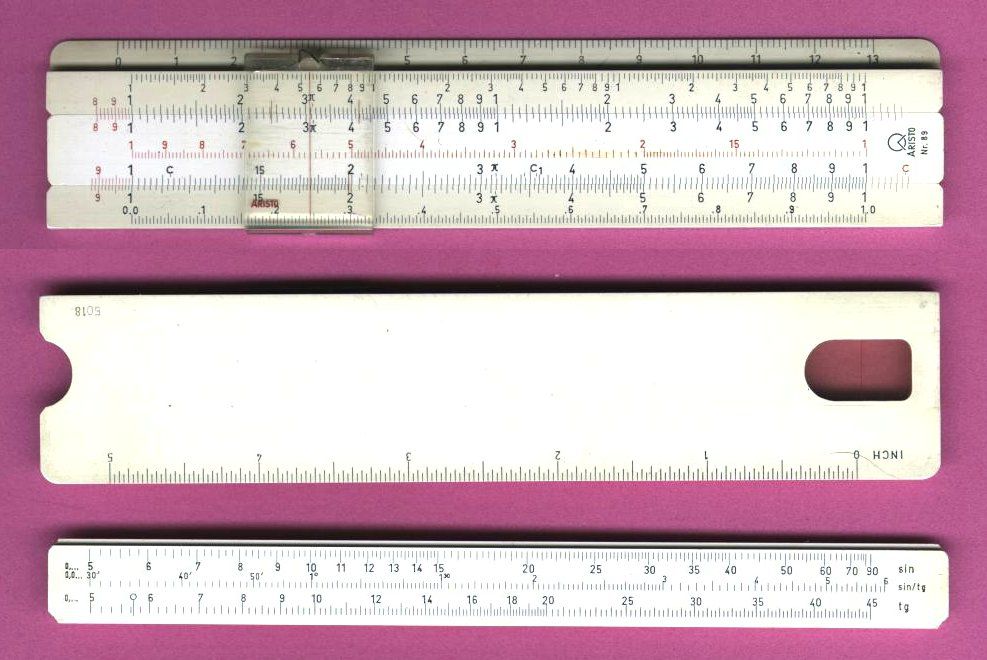
For me (and I freely and proudly admit I am a slide rule fan who carries a slide rule every day) I love that Asimov considered the slide rule such an important device that it wouldn't be superseded by an imagined other technology, it is testimony to the device and its standing at the time in the 1950s. Although they have fallen out of popular use, falling prey to calculators and computers, they are fascinating devices and powerful tools for a variety of tasks to this day. The slide rule I carry everyday (as opposed to the larger ones for home use!!) is an Aristo nr89 which can calculate a surprising number of things by manipulating the slides, multiplication and division, tangents and sines, diagonals of squares, inch to mm conversions, circle areas and more and more. Interestingly for me slide rules also gave me a more concrete feel for logarithmic scales... and.. the Aristo 89 has a metric ruler on the edge so is quite handy for ..heck... drawing lines and measurements. :)

Wednesday, 4 January 2017

Are makers a movement?


Image by Andrewrabbott - Own work, CC BY-SA 4.0, https://commons.wikimedia.org/w/index.php?curid=43664330

So this post is a response to Adrians post .... short version.. we mostly agree!

As ever feel free to ignore.. although I get involved in maker stuff I don't spend much time thinking about the form it takes so others are much better informed than me and indeed my definitions may be well off the mark. However here is my two penneth worth!..

For me I prefer the term maker culture or maker scene as I feel there is a broad culture of people globally linked by making within which I feel there are movements. For me a movement is when a collection of bits come together to create a unified direction towards a common goal...like when 'movement' is used to describe the bits in a clock all working together to make the hands reflect the concept of time. So I think there are lots of movements within maker culture.. but not all makers would align with all movements. So for example;

I see a lot of movement around restart and repair, from the magnificent restart party through to Make's appropriation of the phrase “if you can't open it you don't own it”. This unifies a lot of makers, from circuit bending re-users, to people designing and making ethically sourced repairable embedded systems, to those coming up with ways to reuse plastic bottles.

I see movement around localised production/manufacturing with global design, the fablab idea etc. This movement has a lot going on in it but those makers immersed in areas with lots of manufacturing opportunities might not align with it as a movement as they don't see a need. For example I doubt I'd have thought about PCB fab houses and the ethics and complexity of making at home versus using a UK fab house or euro manufacturer or a far eastern company... if I was a maker based in Shenzen...whereas as a maker halfway up a mountain in rural North Wales I do!

Citizen science, lots of makers I know are involved in citizen science projects and this could be considered a movement within the maker scene, as could many other areas, crypto currency, OSS/FLOSS, renewables, energy monitoring, opendata ...I could go on and on..

However some people are makers purely out of an autodidactic playful trait, in that they tinker with arduinos/launchpads/espxxxx/picaxe/fpga or PCR/geneslicing or CNC/lasers/routers/3dprint or diyspace/satellites/radio/rockets or hand whittle a bowl/spoon just because they want to learn and play with no particular end goal or aim... and this is where making seems more flaneurial than a movement to me.

So why does this subject catch my attention, well the difficulty for me considering the whole of maker culture a movement, is that I feel it could alienate people.. I know plenty of makers who just make. I was chatting the other day with a person who was telling me about their model trains and how they had created a massive logic gate control system for it.... for their own pleasure.. I certainly class this person as an archetypal maker... but part of a movement?... I'm not sure. If movement and common aim becomes the core of maker culture.. do we not kill off its aimless wandering vagabond spirit of freedom?

Thanks for listening. :)


Wednesday, 21 December 2016

OpenRocket 3d print design tip!


So I'm working up some ideas for a high power rocket and aiming to go for my level 1 UKRA certification at some point next year. I'm planning to scratchbuild as much as possible which means it can be tricky to know the exact weights of items you are designing into the rocket.. such as the nosecone which I plan to 3d print.


 I can get a really accurate estimate of what a component is going to weigh by modelling the piece in CAD (I have some code I use in Openscad that generates nosecone geometries based on parameters I feed in) and exporting a .stl file as if I am going to print it.


I then load the stl into the slicer I would use to generate the gcode for my 3d printer "Cura". Rather wonderfully having selected the infill and the material, Cura will give me a weight value of the finished item. I can then jump back into OpenRocket and overide the mass of the component which is then incorporated into the design and adjusts the centre of gravity accordingly. Neat!

Thursday, 8 December 2016

Maker sustainability (or future risks to us doing cool stuff)


A few years ago I was asked to run a stall at a maker event attached to a model engineering exhibition in London. It was a fascinating experience as it linked 2 communities, the live steam/machining/model engineers and the 3dprinting/laser cutting/satellite amateurs etc. It proved to me how much value there is in bringing together these communities and how much we have to offer each other.

There are lots of themes that regularly get discussed around  how much knowledge transfer there is between different groups and its good to see some intergenerational projects going on. I wanted to focus on 3 different communities I have interacted with or am part of, the rocketry community, model engineering (as mentioned) and also amateur/HAM radio  I am saddened when I hear of older members of these groups passing away or indeed the membership of local societies becoming so low they close down. I do indeed mourn the loss of skills and knowledge but I am becoming increasingly aware that we (the maker community) are at risk of losing other stuff, namely structures and accreditation that enable us to do cool stuff.

So.. to provide an example for each group starting with my current favourite subject.. Rockets.

 I want to up my game in 2017 and get into higher power rocket launches and I have plans to try and get my level one certification and also my RSO (Range Safety Officer) exam. Currently the UKRA (UK rocketry association) administer this certification scheme which involve the candidate flying a high power model at a UKRA affiliated club with someone of a higher UKRA certification in attendance and administering the tests etc. Now if had done my certificate some years ago I could have found UKRA affiliate clubs in the Wirral (around 1hrs drive) or around Manchester (1.5-2.5hours). However these clubs have now stopped and my options are Gwent (4-5hrs) Surrey (5-6) or Birmingham (3 hrs). Now this is fine but it shows how vulnerable the certification scheme may be in a few years time... I guess to the point where ultimately this could disappear and the system for people to develop beyond small hobby rockets may not exist.

In model engineering/Live steam similar systems exist (I'm not massively involved in this scene but am aware) for example boiler testing, so if someone builds a model steam engine and wants to run the engine on a club track or on a public running day they need the boiler (a heated high pressure steam filled box!) to be tested and certified as the potential danger if a boiler failed under pressure is probably not dissimilar to a hand grenade! Again this certification system relies on clubs and members of clubs being certified and becoming accredited assessors. (Here is a list of assessors if of use!)

Finally HAM/amateur radio has similar issues in that the exam and certificate systems (although held centrally by the Radio Society of Great Britain RSGB) the actual people providing instruction and hosting and marking and submitting the examinations are clubs and club members. HAM radio does seem to be gaining a lot of support in the maker scene but still some clubs (particularly outside the larger cities) are struggling with an older and perhaps dwindling membership.

So how do we solve this? Well, I'm not sure I have all (or even any) of the answers but part of it is certainly supporting and getting involved in local clubs and if possible becoming involved to the point of being able to assess and accredit others is vital. But also if you are setting up a makerspace/hackspace/techgroup whatever, make sure you spend a bit of time thinking about how you can be sustainable not just in terms of cash flow and membership and knowledge but also certification and accreditation your members might need.

I also wonder if there are more practical stuff to be done? How about the larger maker events (faires, makefests, big hackathons) build in some accreditation events.. this seems an easy win for perhaps the amateur radio foundation license.. (may be more tricky for rocketry certs!)

As for me... I'm off to fill in my UKRA application form and pay my subs for next year.. :)